Department of Electrical and Microelectronic Engineering


Department of
Electrical and Microelectronic Engineering
Overview
The department of Electrical and Microelectronic Engineering (EME) offers bachelor’s, master’s and doctoral degrees that combine the rigor of theory with the flexibility of engineering practice. From technology development to technology application, the innovations of electrical and microelectronic engineers are shaping our future.
The department’s mission is to establish its electrical and microelectronic engineering programs among the top programs in the world by providing high quality, inclusive education that cultivates intellectual curiosity. Our curricula apply mathematical and scientific foundations to the varied electrical and microelectronic disciplines in order to train high quality, independent thinking engineers and researchers that make measurable impacts on the world.
Electrical Engineering
Electrical engineering is a discipline concerned with the study, design, and application of equipment, devices, and systems that use electricity, magnetism, and electromagnetism. The discipline is divided into multiple focus areas, including: Analog and Mixed-Signal Electronics, Electronic Devices and Components, Digital and Computer Systems, Electromagnetics and Waves, Mechatronics, Electrical Power Systems, Telecommunications, Signal Processing, Machine Learning, Artificial Intelligence, Robotics. As a result, electrical engineers work in a wide variety of industries and are required to possess skills such as device modeling, circuit design, system architecture, algorithm development, and project management. Electrical engineers intensively use computer assisted design tools and methods, and test equipment.
Microelectronic Engineering
Microelectronic engineering focuses on the study, design, and fabrication of very small electronic devices and components (micrometer scale or below). These are semiconductor and photonic devices that impact virtually every aspect of human life, from communication, entertainment, and transportation, to health, solid-state lighting, and solar cells. There is an ever-increasing need for talented engineers that not only understand the design of these devices but can direct and optimize their fabrication. Integrated nanoelectronic and microelectronic circuits and sensors drive our global economy, increase our productivity, and help improve our quality of life.
Accreditation
The BS degrees in electrical engineering and microelectronic engineering are accredited by the Engineering Accreditation Commission of ABET, www.abet.org, which certifies that they meet the highest quality standards of the corresponding professions and that the graduates are well prepared to enter a global workforce.
For Enrollment and Graduation Data, Program Educational Objectives, and Student Outcomes, please visit the college’s Accreditation page.
32
Faculty members in electrical and microelectronic engineering
10
Undergraduate, graduate, and accelerated dual degree options
Research
The faculty and students in the electrical and microelectronic engineering department conduct research in a wide range of interdisciplinary fields including, but not limited to: digital and computer systems, signal processing, electromagnetics, power and energy systems, robotics, telecommunications, machine learning, analog and mixed-signal electronics, mechatronics, microelectromechanical systems, semiconductor devices, advanced integrated circuit manufacturing. Research is externally supported by an array of federal, state, and industry sponsors, such as the National Science Foundation, the US Air Force, and the US Navy. Faculty offer research mentorship to BS, MS, and Ph.D. students.
Research Areas


Latest News
-
April 18, 2024
![a headshot of Alireza Vahid appears on the right with his name, title, and department to the left.]()
Engineering professor becomes part of SMART Hub to improve wireless spectrum accessibility
The wireless spectrum has become very crowded real estate, and work is underway through a new technology research center to improve spectrum access, co-existence, and security.
-
April 10, 2024
![a group of researchers gathers around a camera used to capture the eclipse.]()
University researchers measure the sun during the eclipse to assess impact on solar arrays
The recent total solar eclipse over Rochester provided a once-in-a-lifetime opportunity on Earth for two faculty-researchers and their students to capture data about the effects of the sun’s energy during a total eclipse.
-
April 5, 2024
![Dorin Patru is shown in a black suit standing behind an orange chair.]()
Electrical engineering professor connects history with the future for today’s students
Patru’s authenticity and humor are as much a part of his classes as the informal conversations he has with students about mutual interests in space, music, art, and history. These qualities are only a few of the reasons he’s being honored with the Eisenhart Award for Outstanding Teaching.


Featured Work
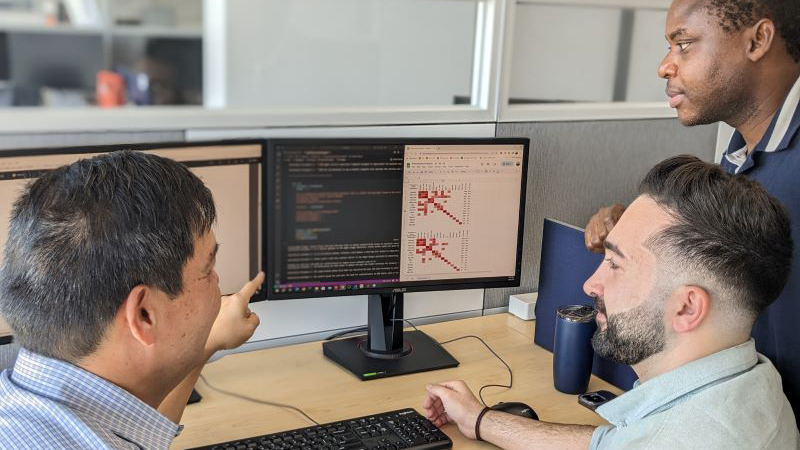
Generative AI enabled Cybersecurity Operations
Shanchieh Jay Yang
The potential use of generative AI, including Large Language Models (LLMs), for cybersecurity operations may be hindered by misconceptions of its capabilities and missed opportunities to properly...
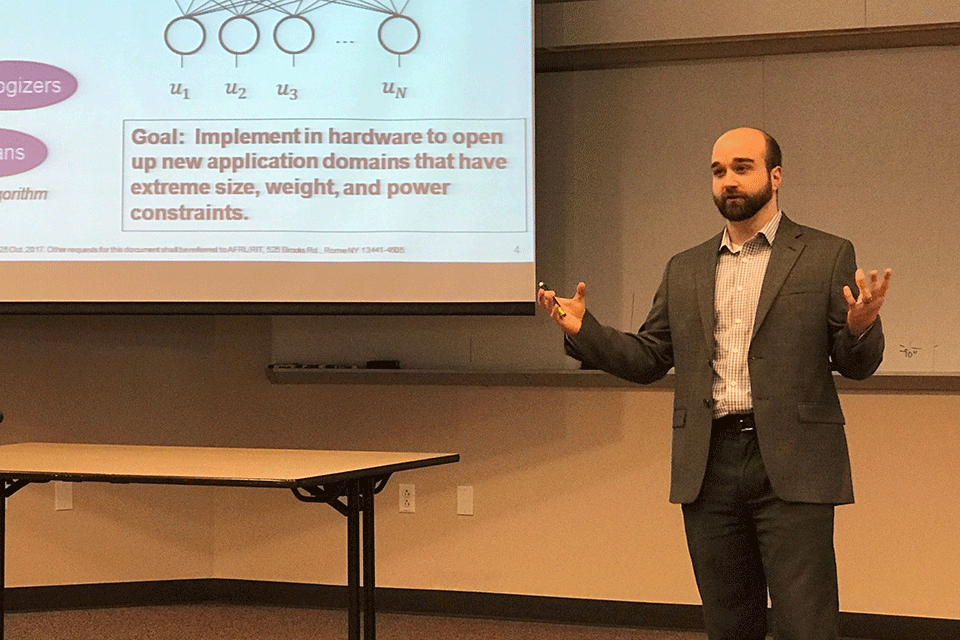
Making AI less artificial and more intelligent
Cory Merkel
Dr. Cory Merkel’s lab—Brain Lab—is exploring cross-disciplinary solutions to improve the agility, energy efficiency, and trustworthiness of AI systems.
Featured Profiles

Grad Contributes to Cutting-edge System for International Space Station
Snehal Ravindra Ingle helped develop the Radio Frequency (RF) Amplifier system used for NASA’s Cygnus spacecraft.

Alumni Spotlight: Matt Hartensveld '18, '21
Matthew Hartensveld BS, MS '18, Ph.D. '21 is the CTO and co-founder of the display startup Innovation Semiconductor, a company pursuing a novel platform for the next generation of display technology.
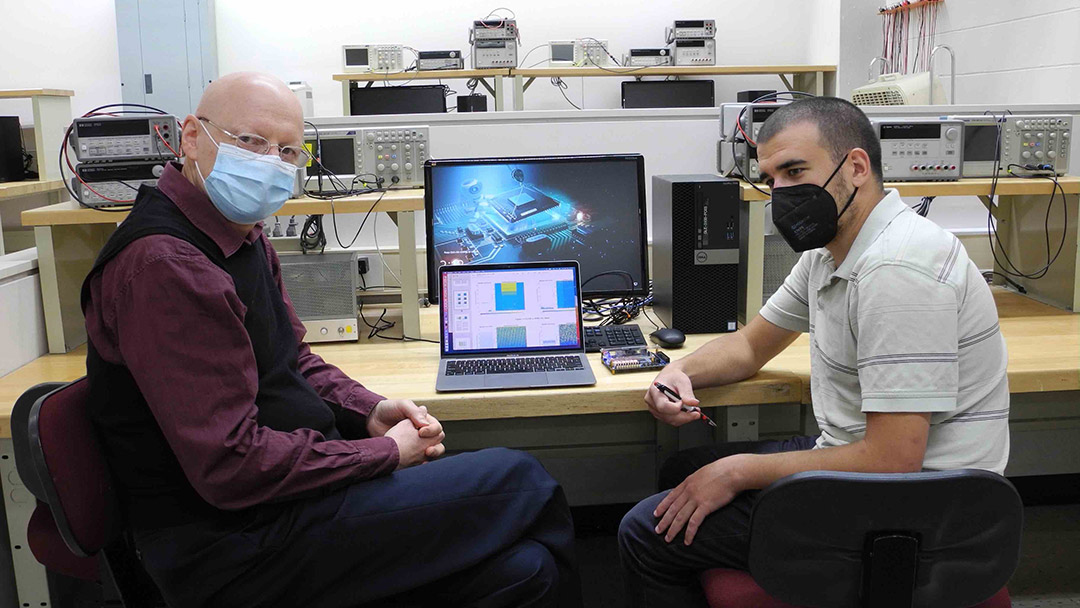
Faculty Spotlight: Dorin Patru
Dorin Patru
Associate professor at RIT since 2002, Dorin Patru teaches digital and computer, circuits and systems courses. He joined the department in fall 2002. He received a B.S. and M.S. in Electrical...


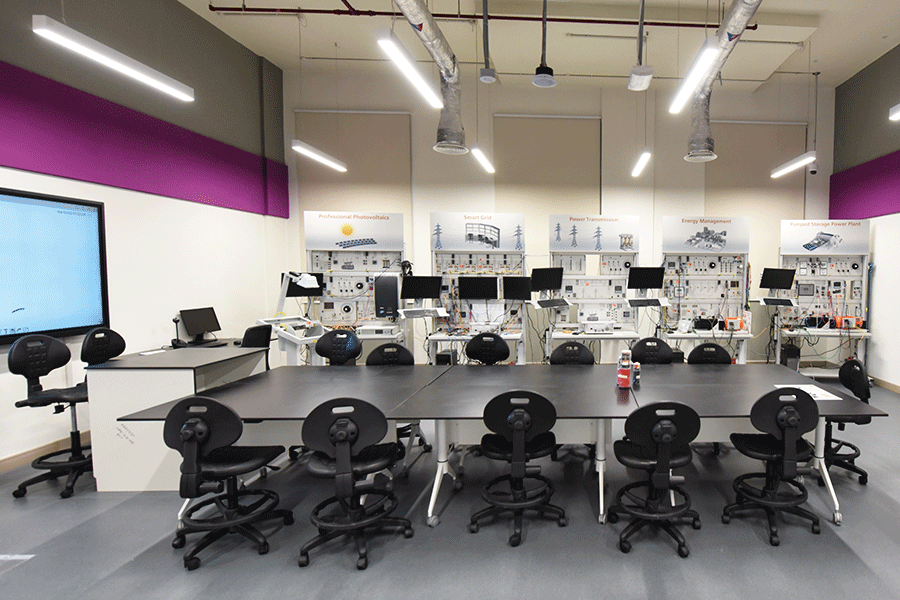

Conferences and Short Courses
Annual Microelectronic Engineering Conference at RIT
The Annual Microelectronic Engineering Conference (AMEC) at RIT started in 1983 as a means of bringing together students, faculty, alumni, and industry interested in microelectronic engineering.
Learn More
Short Courses
Short courses are comprehensive, hands-on, educational experiences intended for individuals seeking a better understanding of the overall theory and practice of microelectronic engineering.
Learn More
Student Resources
The Electrical and Microelectronic Engineering Department offers a variety of resources for our students that vary from academic support to handbooks and more. Visit our Student Resources page for more information.